
How to Start a Career in Cybersecurity Without a Degree: A 2026 Guide
In the modern digital age, data is the new oil, and protecting that data is one of the most critical challenges facing the global economy. Consequently, launching a career in cybersecurity has become one of the most lucrative, stable, and exciting professional paths available today.
There is a widespread myth that you need a four-year computer science degree or a background in advanced mathematics to enter this field. This is not true. While a degree helps, the cybersecurity industry is unique; it prioritizes practical skills, certifications, and hands-on experience over university diplomas. Companies like Google, Apple, and IBM have all dropped degree requirements for many of their tech roles, focusing instead on what a candidate can actually do.
If you are curious, analytical, and willing to learn, you can build a successful career in this high-demand sector. This guide will serve as your comprehensive roadmap, taking you from a complete beginner to a job-ready candidate, covering the essential skills, certifications, and strategies you need to succeed in 2026.

Understanding the Cybersecurity Landscape
Before diving into the technical skills, it is essential to understand what a cybersecurity professional actually does. It is not always about “hacking” in a dark room wearing a hoodie. The field is vast and includes various roles, such as:
- Security Analyst: The “Blue Team.” They monitor networks for security breaches, investigate violations, and install firewalls.
- Penetration Tester (Ethical Hacker): The “Red Team.” They are hired to simulate cyberattacks to identify weak spots in a system before bad actors do.
- Security Architect: Designs robust security structures and protocols to prevent attacks.
- Incident Responder: The “firefighter” who jumps in when a breach occurs to mitigate damage and recover data.
The industry is currently facing a massive talent shortage. Companies are desperate for skilled workers who can secure their infrastructure against ransomware, phishing, and data theft. This gap creates a gigantic opportunity for self-taught individuals to step in.
Step 1: Master the IT Fundamentals
You cannot secure a network if you do not understand how it works. A common mistake beginners make is jumping straight into “hacking” tools like Kali Linux without understanding the underlying technology. This is like trying to be a mechanic without knowing how an engine functions.
Networking Basics
Networking is the backbone of the internet. You must understand how data moves from point A to point B.
- IP Addresses & Subnetting: Learn how devices are identified on a network.
- OSI Model: Memorize the 7 layers of the OSI model. It is crucial for troubleshooting.
- Protocols: Understand HTTP, HTTPS, FTP, SSH, DNS, and DHCP. Know what ports they use and what their vulnerabilities are.
Operating Systems (OS)
You need to be comfortable with more than just the basic consumer interface.
- Linux: This is non-negotiable. Most security tools run on Linux. You must learn how to navigate the terminal, manage packages, and manipulate files using the command line. Start with user-friendly distributions like Ubuntu before moving to Kali Linux.
- Windows: Since most corporate environments use Windows, you need to understand Active Directory, PowerShell, and how permissions work.

Step 2: Learn Basic Coding and Scripting
Do you need to be a master programmer? No. Do you need to read and understand code? Absolutely.
As a cybersecurity professional, you will often need to automate tasks, analyze malware, or understand how a script is attacking a system.
- Python: The most popular language for security professionals. It is easy to read and has powerful libraries for network scanning and packet analysis.
- Bash Scripting: Essential for automating tasks in Linux.
- PowerShell: Essential for automating tasks in Windows environments.
You don’t need to build the next Facebook, but you should be able to write a script that scans a log file for suspicious IP addresses.
Step 3: Get Certified (The Degree Alternative)
Since you are skipping the degree, certifications are your “proof of knowledge.” They validate your skills to HR managers and automated hiring systems. Here is the recommended path for beginners:
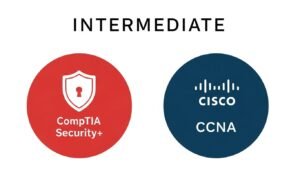
1. CompTIA Security+
This is the gold standard for entry-level cybersecurity roles. It covers the core principles of network security and risk management. Many government and defense jobs require this certification as a minimum baseline.
2. CompTIA Network+ (or CCNA)
Before Security+, you should take Network+. It proves you understand networking deeply. Alternatively, the Cisco Certified Network Associate (CCNA) is harder but highly respected.
3. Specialized Certifications (Later Stage)
Once you have the basics, you can branch out:
- Certified Ethical Hacker (CEH): Good for penetration testing roles.
- CySA+: Great for security analyst roles.
- CISSP: An advanced management certification (save this for when you have 5+ years of experience).
Step 4: Build a Home Lab and Get Hands-On
Theory is good, but practice is everything. Employers want to know what you have built and what you have broken. You can set up a virtual lab on your own computer for free using software like VirtualBox or VMware.
What to do in your Home Lab:
- Set up a Virtual Machine (VM): Install Kali Linux.
- Practice on “Vulnerable” Machines: Download intentionally broken machines like “Metasploitable.” Try to hack into them using the tools you are learning. Never hack a real website or network without permission.
- Capture The Flag (CTF): Join platforms like TryHackMe or Hack The Box. These are gamified learning platforms where you solve security puzzles. They offer guided paths that are incredible for beginners.
Ranking up on Hack The Box is a legitimate achievement that you can put on your resume. It shows passion and practical ability.
Step 5: Soft Skills and Documentation
This is the secret weapon that technical people often ignore. A cybersecurity pro doesn’t just find a bug; they have to explain it to the CEO, who has zero technical knowledge.
- Report Writing: Can you write a clear report explaining a vulnerability and how to fix it?
- Communication: Can you stay calm during a crisis?
- Ethics: You will have access to sensitive data. Integrity is your most valuable currency.
Step 6: Job Hunting and Networking
You have the skills, the certs, and the lab experience. Now, how do you get hired?
The “Stepping Stone” Strategy
It is rare to land a “Cybersecurity Analyst” role as your very first job. Most professionals start in the IT Help Desk or System Administration.
- Why Help Desk? It teaches you how enterprise technology breaks and how to deal with users. Treat a Help Desk job as a paid internship. While you are there, volunteer for security tasks. Ask the security team if you can help with logs or patch management.
Optimize Your LinkedIn
- Connect with other security professionals.
- Post about what you are learning. Did you finish a TryHackMe room? Post a screenshot.
- Follow industry leaders and stay updated on the latest news (like zero-day vulnerabilities).
Conclusion: Persistence is Key
Starting a career in cybersecurity without a degree is challenging, but entirely possible. It requires a shift in mindset from “passive learning” to “active problem solving.”
The technology changes every day. What is secure today might be vulnerable tomorrow. Therefore, the most critical skill you can cultivate is the ability to teach yourself. Start with the fundamentals, earn your Security+, build your home lab, and don’t be afraid to start in an entry-level IT role to get your foot in the door.
The industry needs you. The roadmap is clear. The only remaining step is for you to start walking it.